Why Interest (Riba) Is Not Allowed in Islamic Finance
- salsabeelahk

- Apr 27
- 3 min read
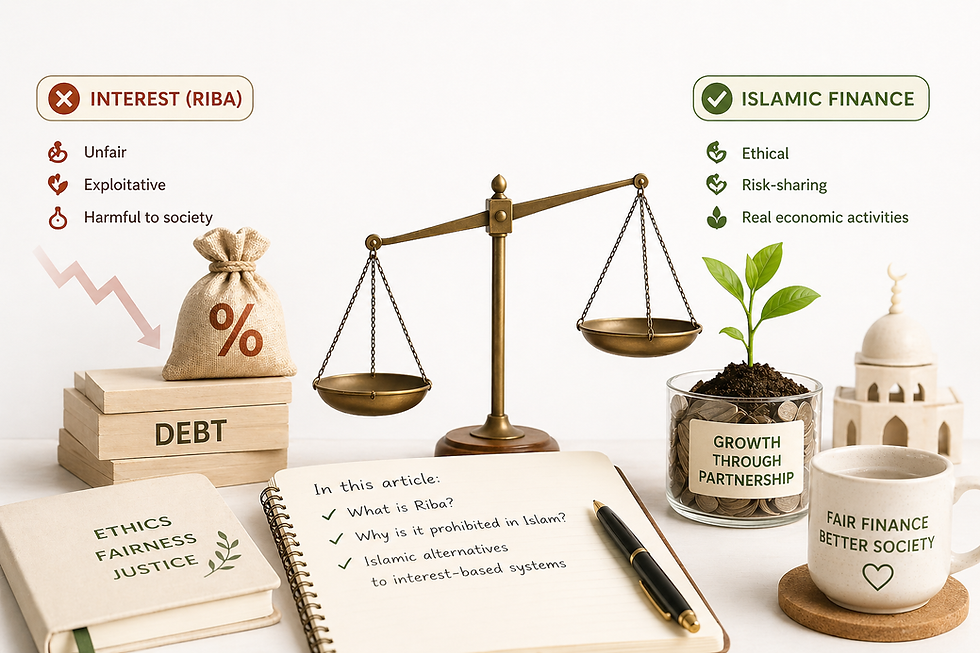
Why does Islamic finance forbid interest? This is one of the most common questions people ask about Islamic banking. In Islamic finance, interest known as riba is strictly prohibited because it is considered unfair, exploitative, and harmful to society. Instead of earning money from interest, Islamic finance focuses on ethical, risk-sharing, and real economic activities.
In this article, we’ll explain what riba means, why it is prohibited in Islam, and how Islamic finance offers alternatives to interest-based systems.
What Is Riba?
In simple terms, riba refers to any guaranteed increase on a loan or exchange without corresponding risk or real economic activity.
The prohibition of riba is clearly mentioned in the Qur'an (Surah Al-Baqarah, 2: 275 - 279), where it is strongly discouraged due to its harmful effects on individuals and society.
For example:
Lending RM1,000 and demanding RM1,100 in return.
Charging interest on loans regardless of the borrower’s situation.
In Islamic finance, money is not seen as something that can grow on its own. Instead, money should be used to create real value through trade, investment, and partnerships.
Why Is Riba Prohibited in Islamic Finance?
1) It Creates Unfairness and Exploitation
Interest often benefits lenders at the expense of borrowers. Even if a business fails or a person faces hardship, interest continues to accumulate. This can trap people in debt and widen the gap between the rich and poor.
2) It Encourages Risk-Free Profit
In conventional finance, lenders earn guaranteed returns without sharing any risk. In Islamic finance, profit should come with risk and shared responsibility. This ensures fairness between all parties.
3) It Disconnects Money from Real Economic Activity
Interest-based systems allow money to grow without being linked to real assets or productive activities. On the other hand, Islamic finance requires transactions to be backed by real goods, services, or projects.
4) It Promotes Ethical and Social Justice
Islamic finance aims to build a just and balanced economy. Also, it encourages cooperation, fairness, and shared prosperity rather than exploitation by prohibiting riba.
How Does Islamic Finance Work Without Interest?
Instead of interest, Islamic finance uses alternative contracts, such as:
Murabaha – Cost-plus financing (buying and selling with a profit margin).
Mudarabah – Profit-sharing partnership between investor and entrepreneur.
Musharakah – Joint partnership where all parties share profit and risk.
Ijarah – Leasing arrangements.
Salam and Istisna’ – Contracts for future delivery of goods or projects.
These models ensure that profits come from real economic activities, not from interest.
Simple Example: Interest vs Islamic Finance
Conventional Loan
A bank lends RM10,000 and charges 10% interest. The borrower must repay RM11,000, even if the business fails.
Islamic Financing
The bank invests in the business through a partnership. If the business succeeds, both parties share the profit. If the business fails, losses are shared based on the agreement, rather than being placed entirely on one party. This shows how Islamic finance promotes fairness and shared responsibility.
FAQs About Riba in Islamic Finance
1. Is all interest considered riba?
In Islamic finance, most scholars agree that any guaranteed interest on loans is considered riba and is prohibited.
2. Why is riba seen as harmful?
Riba can contribute to debt traps, inequality, and financial instability because it allows profit without risk or real value creation.
3. Is Islamic finance the same as conventional finance?
No. The main difference is that Islamic finance avoids interest and focuses on risk-sharing and real economic activities.
Final Thoughts
The prohibition of riba in Islamic finance is not just a religious rule, it reflects a deeper vision of fairness, responsibility, and ethical economic growth. Islamic finance encourages risk-sharing, real value creation, and social justice by rejecting interest-based transactions.
While conventional finance focuses on guaranteed returns, Islamic finance emphasizes partnership, transparency, and mutual benefit. This approach not only protects individuals from exploitation but also promotes a more balanced and sustainable financial system.
Understanding why riba is prohibited helps us see that Islamic finance is not about restricting wealth, but about creating a fairer way to grow it. As global interest in ethical and sustainable finance continues to rise, the principles of Islamic finance offer valuable lessons for both Muslims and non-Muslims alike.
References
AAOIFI. Accounting and Auditing Organization for Islamic Financial Institutions
Islamic Financial Services Board (IFSB) – Guiding Principles of Islamic Finance
Bank Negara Malaysia – Islamic Banking & Finance Overview
World Bank – Islamic Finance Overview
Islamic Development Bank Institute – Islamic Finance Basics & Concepts
Qur’an – Surah Al-Baqarah (2:275–279)


Comments